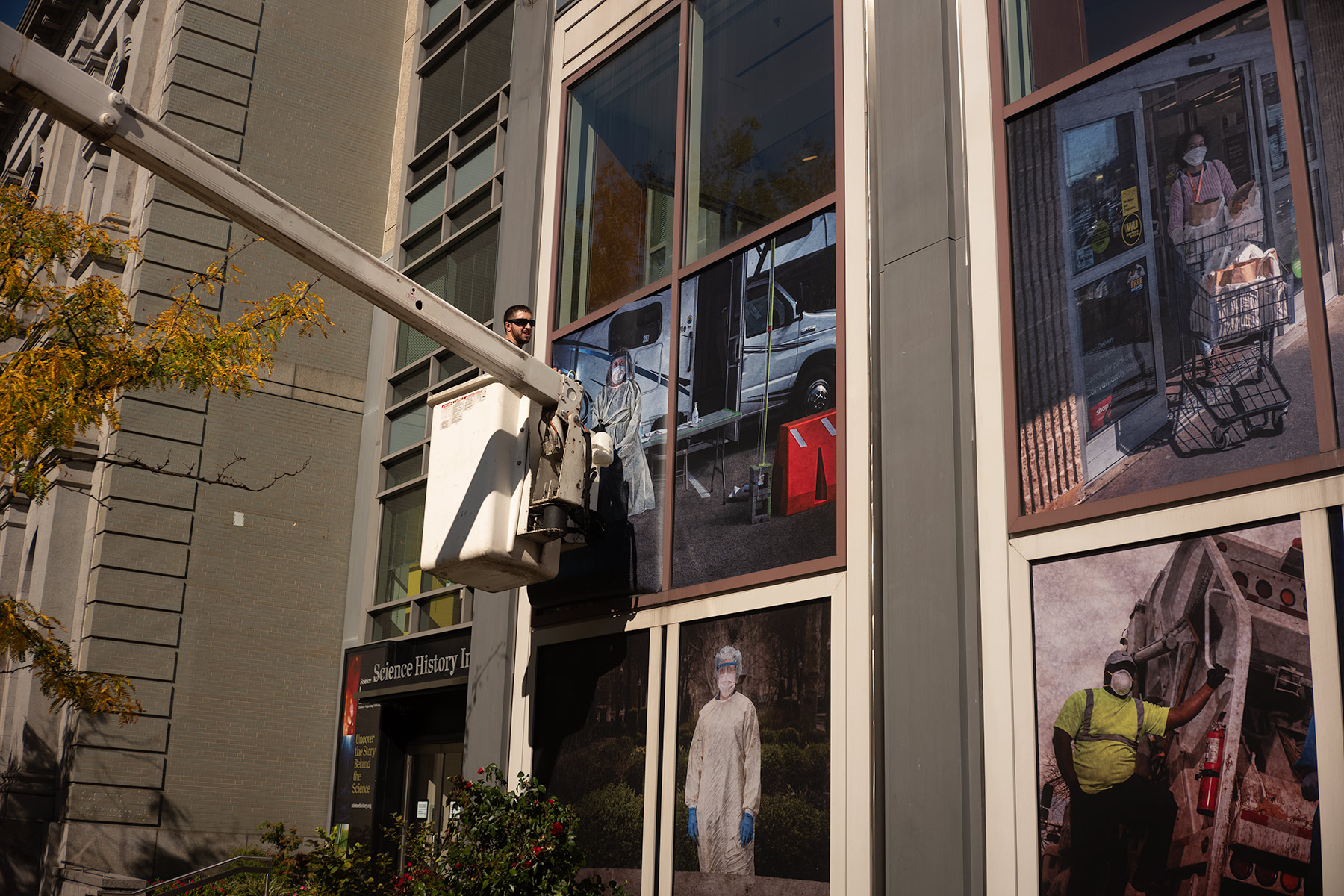
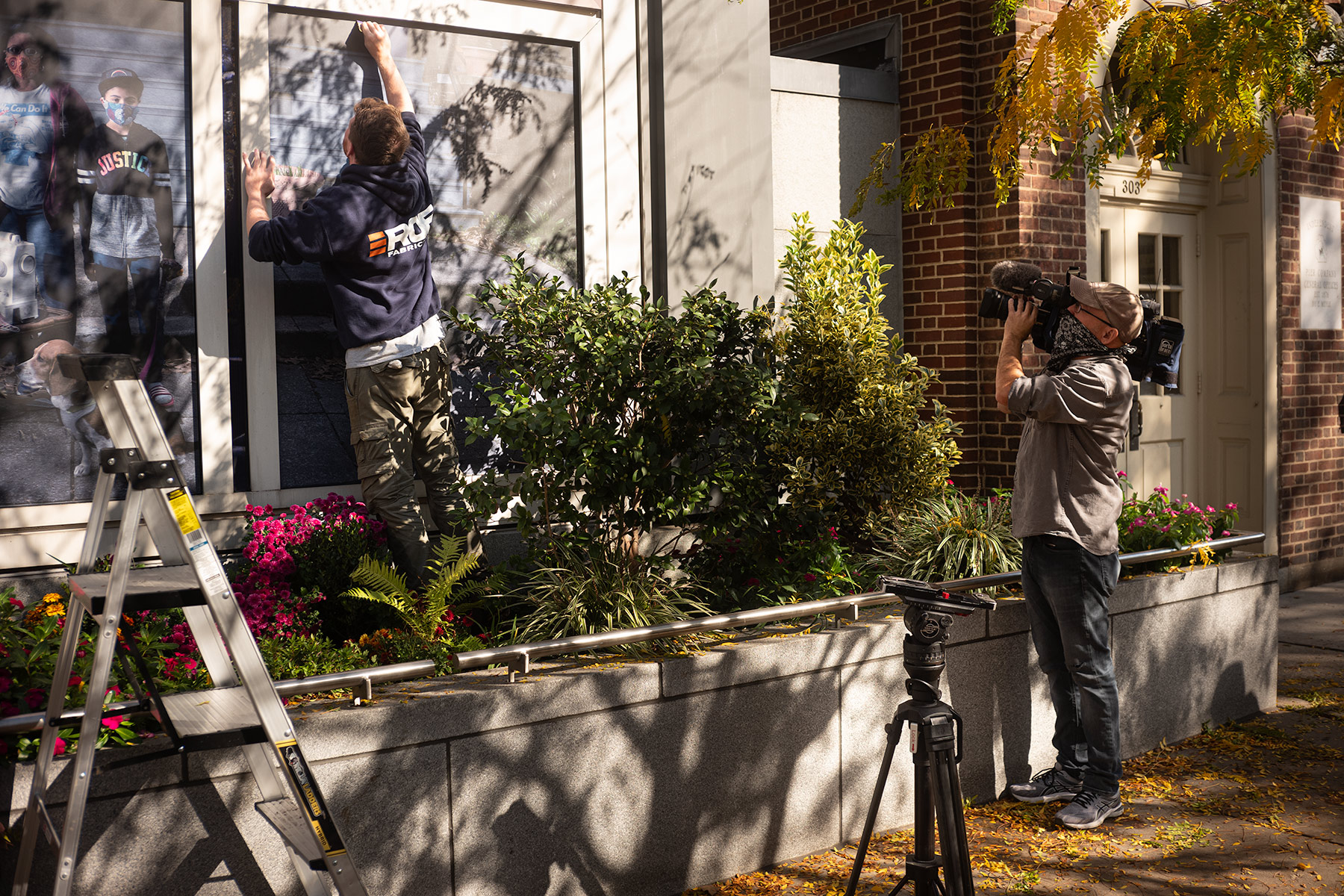
Science History Institute, 2021

The Science History Institute, January 2021 - January 2023. .

Between Us and Catastrophe. A life-sized COVID-safer outdoor exhibit.
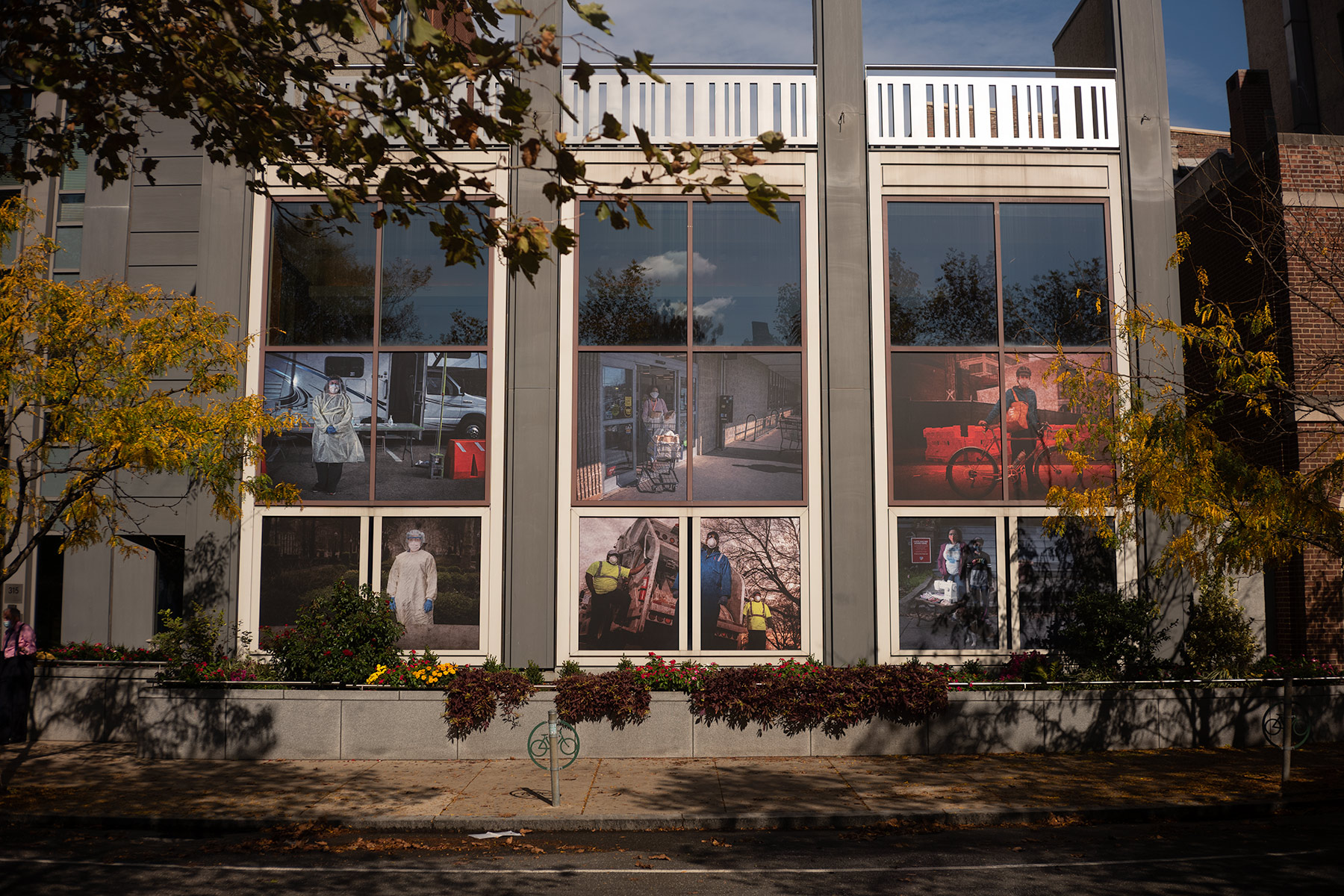
The exhibit installed.

CAMRA 2024

The collective for Advancing Multimodal Research Arts (CAMRA) and the Screening Scholarship Media Festival (SSMF) 2024 "Practices of Resurrection and Necromancy" April 19-20th. .

Between Us and Catastrophe. A visual oral history of COVID-19 Nurses.

Signage for the exhibit.

Short description of the exhibit: Portraits and interviews with twenty ICU & Emergency Room nurses who worked in places from Virginia to Boston, beginning on 3/23/2020 and continuing through today. Some, photographed yearly at the same day, time and place. The Exhibit also includes a number of melt-blown and woven fiber textile mask materials.

"We had a lot of COVD patients who were really, really sick. When they got off the ventilator, onto regular oxygen they could leave the ICU. But I didn’t have any patients that left, I didn’t ever have any patients who lived." --Linda, ICU Nurse, June 30, 2022

The ICU is a place where the collected scientific wisdom of humanity is focused. With potions & careful alchemy, the faintest glow of life can be rekindled from the dead or barely living. It is the realized culmination of an aeonic struggle to conquer death. But that space is inhabited by mere humans, who, for all their majicks, suffer the anguish of the ordinary.

The process of reviving the dead, even metaphorically, is built of bricks of failure. For 4 years doctors and nurses worked to revive “coded” COVID-19 patients -- to bring them back to life after the virus had consumed them. Almost every one of these attempts failed.

This work is a secret visual history of how the shadow of death remains on those who bore witness that not even the celebration of the rare return from death can assuage.

“Before, you’d send someone to the ICU & later think, ‘I wonder what happened to them?’ And you’d see ‘left for rehab’, ‘getting better’, and think, ‘That’s good!’ Now you look them up and it’s just dead, dead, dead, dead — everyone you took care of is dead.” --Alex-ER Nurse, January 6, 2021

Keywords: Gendered-labor, resilience, reclaiming value, bearing witness, socio-emotional

Exhibit description: The complete work consists of more than 200 images and hours of interviews, although it is easy to create smaller exhibition series’ from this and it can be curated to fit any space. Each image (with a few exceptions) is a combination of a photographic image printed through a textile fiber mask. There are also text panels with interview excerpts from the oral history. The preferred exhibit is 24x36 inch panels printed on foamboard, though printing some images at a smaller size is perfectly acceptable to adapt to available space. (The exhibit could be configured to fit in a phone booth, a van, a restroom -- it’s very adaptable.) The foamboard is lightweight, easily replaceable and can be hung with non-destructive adhesive.

The exhibit also includes a variable number of 8x10 floating frames that contain reclaimed melt-blown and woven fiber protective mask materials. Ideally these should be in a place without direct sunlight but they can be draped.

There is an audio/video component which will play on a large screen.
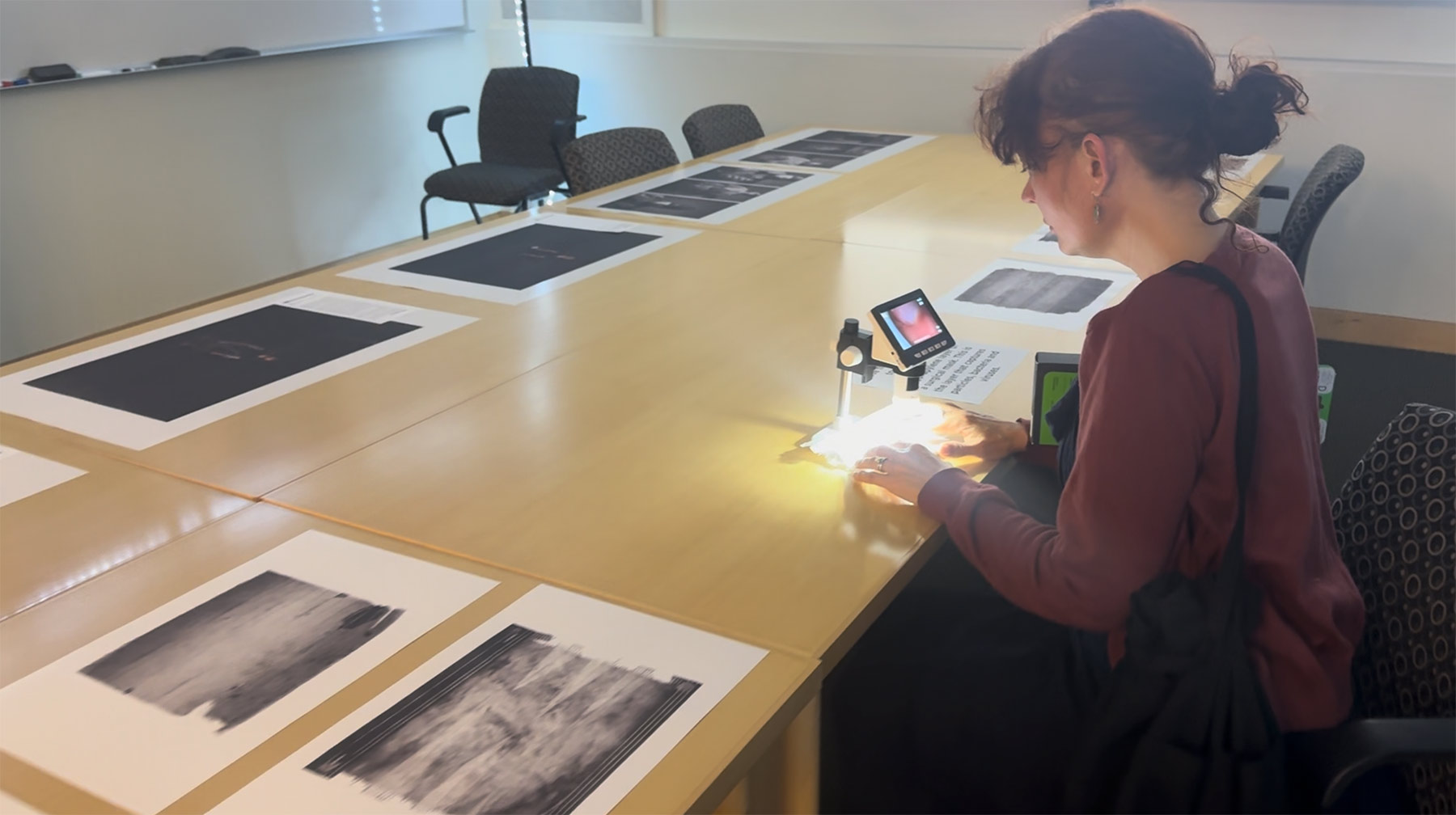
Click here to watch a 70 second video tour of the exhibit.

Mütter Museum 2025–2026

The Mütter Museum of the College of Physicians of Philadelphia, “Trusted Messengers,” March 15, 2025 – February 2, 2026.

Between Us and Catastrophe. Part of the long-term exhibition Trusted Messengers, commemorating five years since the start of the COVID-19 pandemic and focusing on the stories of Philadelphia’s nurses and other front-line health care workers.

Short description of the exhibit: A selection of portraits and interviews from Between Us and Catastrophe is integrated into Trusted Messengers, alongside materials on the city’s pandemic response, vaccine development at Penn’s Weissman Lab, and public health messaging that sought to cut through misinformation and mistrust.
Mütter Museum to display work of Philly photographer who followed local nurses during the COVID-19 pandemic
'Trusted Messengers' exhibit, which opens Saturday, will include materials from vaccine development at Penn's Weissman Lab.
Franki RudneskyBY FRANKI RUDNESKY
PhillyVoice Staff


HEALTH NEWS COVID-19
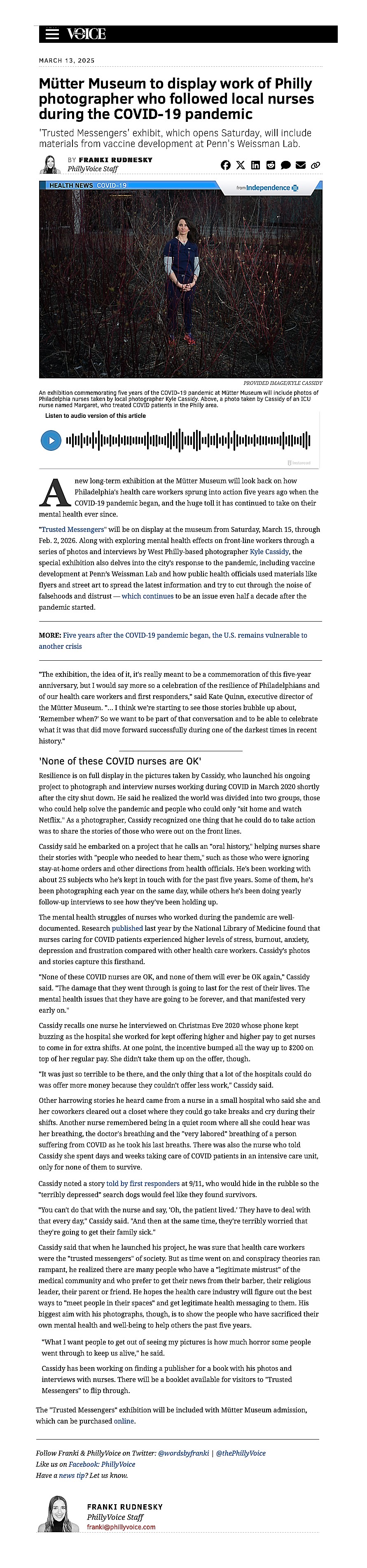
from  IBC-Logo-125x21 covid-19 mutter museum kyle cassidy PROVIDED IMAGE/KYLE CASSIDY An exhibition commemorating five years of the COVID-19 pandemic at Mütter Museum will include photos of Philadelphia nurses taken by local photographer Kyle Cassidy. Above, a photo taken by Cassidy of an ICU nurse named Margaret, who treated COVID patients in the Philly area.

A new long-term exhibition at the Mütter Museum will look back on how Philadelphia's health care workers sprung into action five years ago when the COVID-19 pandemic began, and the huge toll it has continued to take on their mental health ever since.

"Trusted Messengers" will be on display at the museum from Saturday, March 15, through Feb. 2, 2026. Along with exploring mental health effects on front-line workers through a series of photos and interviews by West Philly-based photographer Kyle Cassidy, the special exhibition also delves into the city's response to the pandemic, including vaccine development at Penn’s Weissman Lab and how public health officials used materials like flyers and street art to spread the latest information and try to cut through the noise of falsehoods and distrust — which continues to be an issue even half a decade after the pandemic started.

"The exhibition, the idea of it, it's really meant to be a commemoration of this five-year anniversary, but I would say more so a celebration of the resilience of Philadelphians and of our health care workers and first responders," said Kate Quinn, executive director of the Mütter Museum. "... I think we're starting to see those stories bubble up about, 'Remember when?' So we want to be part of that conversation and to be able to celebrate what it was that did move forward successfully during one of the darkest times in recent history."


'None of these COVID nurses are OK'
Resilience is on full display in the pictures taken by Cassidy, who launched his ongoing project to photograph and interview nurses working during COVID in March 2020 shortly after the city shut down. He said he realized the world was divided into two groups, those who could help solve the pandemic and people who could only "sit home and watch Netflix." As a photographer, Cassidy recognized one thing that he could do to take action was to share the stories of those who were out on the front lines.

Cassidy said he embarked on a project that he calls an "oral history," helping nurses share their stories with "people who needed to hear them," such as those who were ignoring stay-at-home orders and other directions from health officials. He's been working with about 25 subjects who he's kept in touch with for the past five years. Some of them, he's been photographing each year on the same day, while others he's been doing yearly follow-up interviews to see how they've been holding up. 

The mental health struggles of nurses who worked during the pandemic are well-documented. Research published last year by the National Library of Medicine found that nurses caring for COVID patients experienced higher levels of stress, burnout, anxiety, depression and frustration compared with other health care workers. Cassidy's photos and stories capture this firsthand. 

"None of these COVID nurses are OK, and none of them will ever be OK again," Cassidy said. "The damage that they went through is going to last for the rest of their lives. The mental health issues that they have are going to be forever, and that manifested very early on."

Cassidy recalls one nurse he interviewed on Christmas Eve 2020 whose phone kept buzzing as the hospital she worked for kept offering higher and higher pay to get nurses to come in for extra shifts. At one point, the incentive bumped all the way up to $200 on top of her regular pay. She didn't take them up on the offer, though. 

"It was just so terrible to be there, and the only thing that a lot of the hospitals could do was offer more money because they couldn't offer less work," Cassidy said. 

Other harrowing stories he heard came from a nurse in a small hospital who said she and her coworkers cleared out a closet where they could go take breaks and cry during their shifts. Another nurse remembered being in a quiet room where all she could hear was her breathing, the doctor's breathing and the "very labored" breathing of a person suffering from COVID as he took his last breaths. There was also the nurse who told Cassidy she spent days and weeks taking care of COVID patients in an intensive care unit, only for none of them to survive.

Cassidy noted a story told by first responders at 9/11, who would hide in the rubble so the "terribly depressed" search dogs would feel like they found survivors.

"You can't do that with the nurse and say, 'Oh, the patient lived.' They have to deal with that every day," Cassidy said. "And then at the same time, they're terribly worried that they're going to get their family sick."

Cassidy said that when he launched his project, he was sure that health care workers were the "trusted messengers" of society. But as time went on and conspiracy theories ran rampant, he realized there are many people who have a "legitimate mistrust" of the medical community and who prefer to get their news from their barber, their religious leader, their parent or friend. He hopes the health care industry will figure out the best ways to "meet people in their spaces" and get legitimate health messaging to them. His biggest aim with his photographs, though, is to show the people who have sacrificed their own mental health and well-being to help others the past five years.


"What I want people to get out of seeing my pictures is how much horror some people went through to keep us alive," he said. 

Cassidy has been working on finding a publisher for a book with his photos and interviews with nurses. There will be a booklet available for visitors to "Trusted Messengers" to flip through. Newspaper coverage of the exhibit.